SOVIET OR DIALECTICAL MONTAGE (Sergei Eisenstein)
CONTINUITY MONTAGE (DW Griffith)
Theory of montage:
Putting together shots to make a more interesting visual language.
Montage = assembly of shots
End of WWI
Russia impoverished and
after the end of WWI 160 million people
Film means of mass communication
pre-revolutionary cinema was a capitalist cinema- filmmakers were driven out
New cinema committee was created as well as a new film school
founded in 1919.
The world's first film school.
Newsreels were to be used to support the new regime- agitation and propaganda = agitprop
people also wanted to study film
Lev Kuleshov- was pre-revolutionary filmmaker who shot newsreels during the long civil war
He was allowed to set up his own workshop with students to study film.
INTOLERANCE- movie by DW Griffith was made in 1916 and was fascinating to the Russians who deconstructed the editing style and the shots themselves in order to understand film language.
Kuleshov Effect- alternating shots of the identical expressionless face between three other shots reveals that the shot of different objects will impact the way the audience interprets the
the meaning of film emerges not only from spatial composition but also
through the order or arrangement of the shots
CREATIVE GEOGRAPHY (viewer constructs geography themselves as they are guided by the arrangement of shots)
Film transcends space and time-= film is born in the edit
MONTAGE- from French verb monter = assemble
Sergei Eisenstein was a student at the school; considered a peer with Griffith who developed continuity and theatrical impact. Eisenstein used an intellectual approach to build ideas.
"Battleship Potemkin" the film was pure propaganda DIALECTICAL CINEMA--> Thesis--> antithesis --> Synthesis
(Marxist dialectic) image of state--> image of people rising up --> suppression by state
Suppression by the state --> helplessness (shot of vulnerable) --> brutal oppression
kinds of MONTAGE
METRIC MONTAGE (duration of cut)
RHYTHMIC MONTAGE
TONAL MONTAGE
OVERTONAL MONTAGE (how sequences play against each other)
IDEOLOGICAL MONTAGE (expresses abstract ideas by posing relationships)
(in Potemkin- the lions, priests and soldiers)
DW Griffith made films starting in 1908. Although we know him best for the racist film Birth of a Nation (1915), he had already developed many of the strategies about how to shoot and cut in order to create a realistic world. Some of the things he developed include the 180 degree rule and matching eyelines.
This was famous at the time for seeming real but being a total fake. "Holzman, an earnest young Godard-hound, decides to film his life in order to understand it—and only succeeds in ruining it. As a voyeur, a gentle intruder into other people’s lives, he can’t understand that the filming makes his subjects feel self-conscious, or that “reality” is altered by the presence of his camera and his tape recorder and his lavalier mike, which he calls his “friends.”" From IFC website
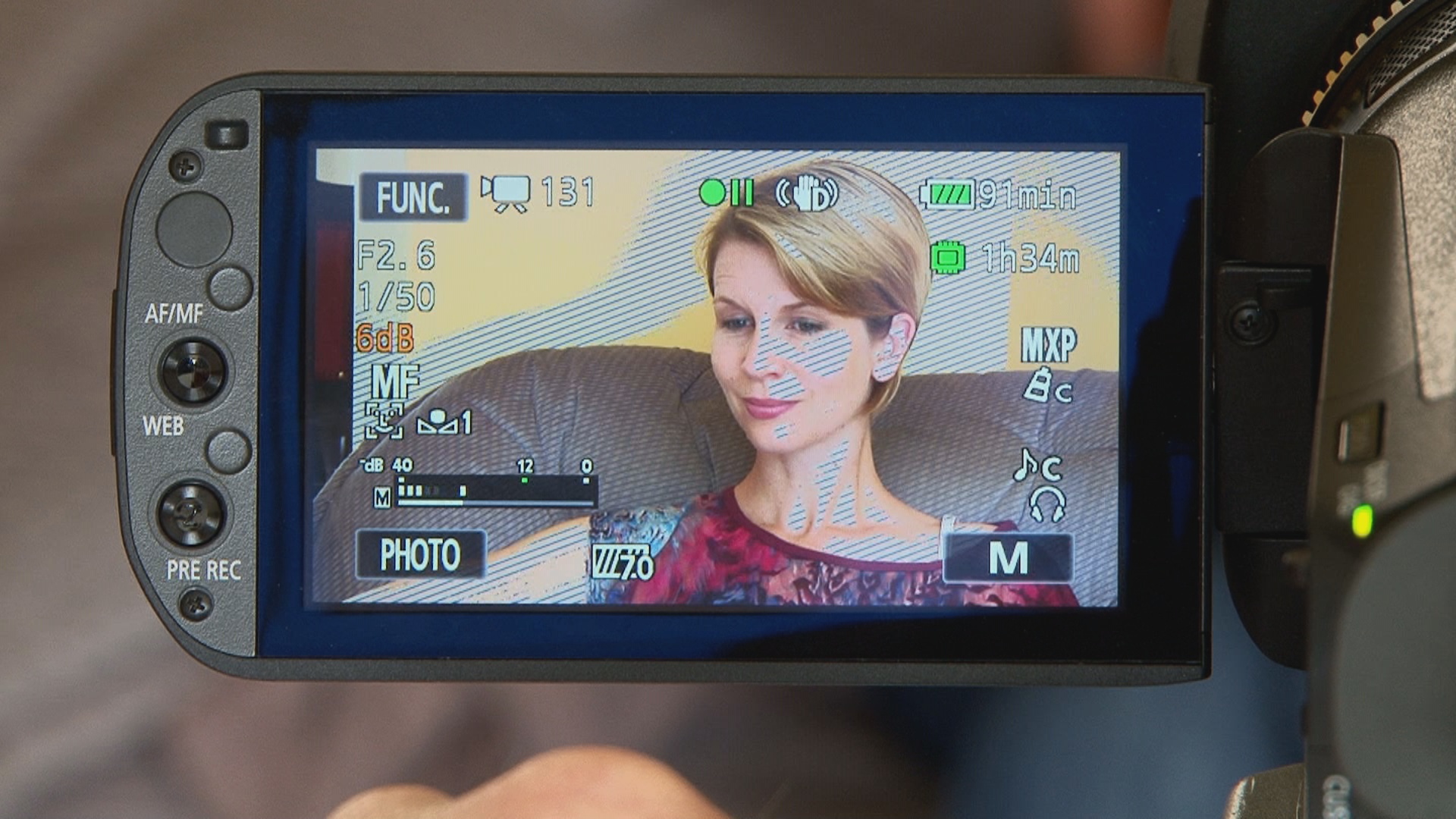
The zebra pattern is a guide for choosing the right brightness in a shot.
Learn where the Zebra button is on the HDR AX2000
When you select the zebra ON, the brightness level appears on the screen. It will not be recorded.
There should be some lines in your scene for it to be bright enough to record.
Lines in the brightest areas, say on the face, is a good indicator.
You can set the threshold of the Zebras to 70% or 100% or other values. The lower the number, the less sensitive they are-- useful for different complexions.. A lower value is better for people with darker complexions. Start by exposing at 70%
In the below image, it shows the lightest part of the scene, the sky.
If there are lines everywhere, or on more than half of the image, your scene is probably overexposed. Close down the IRIS, or change your aperture to AUTO.
Zebras covering the entire face means there is not enough shadow to show depth in the face.
Here's a good exposure. the IRE (zebra values) is set on 70%